


The short answer
Most ice maker problems, such as no ice, slow production, small or hollow cubes, leaks, or a unit that won't drain, come from a fixable part like the inlet valve, the fill line, the ice maker module, or the drain pump. On a high-end built-in or undercounter unit, repair is usually the sensible choice unless the sealed cooling system has failed or parts are no longer available.
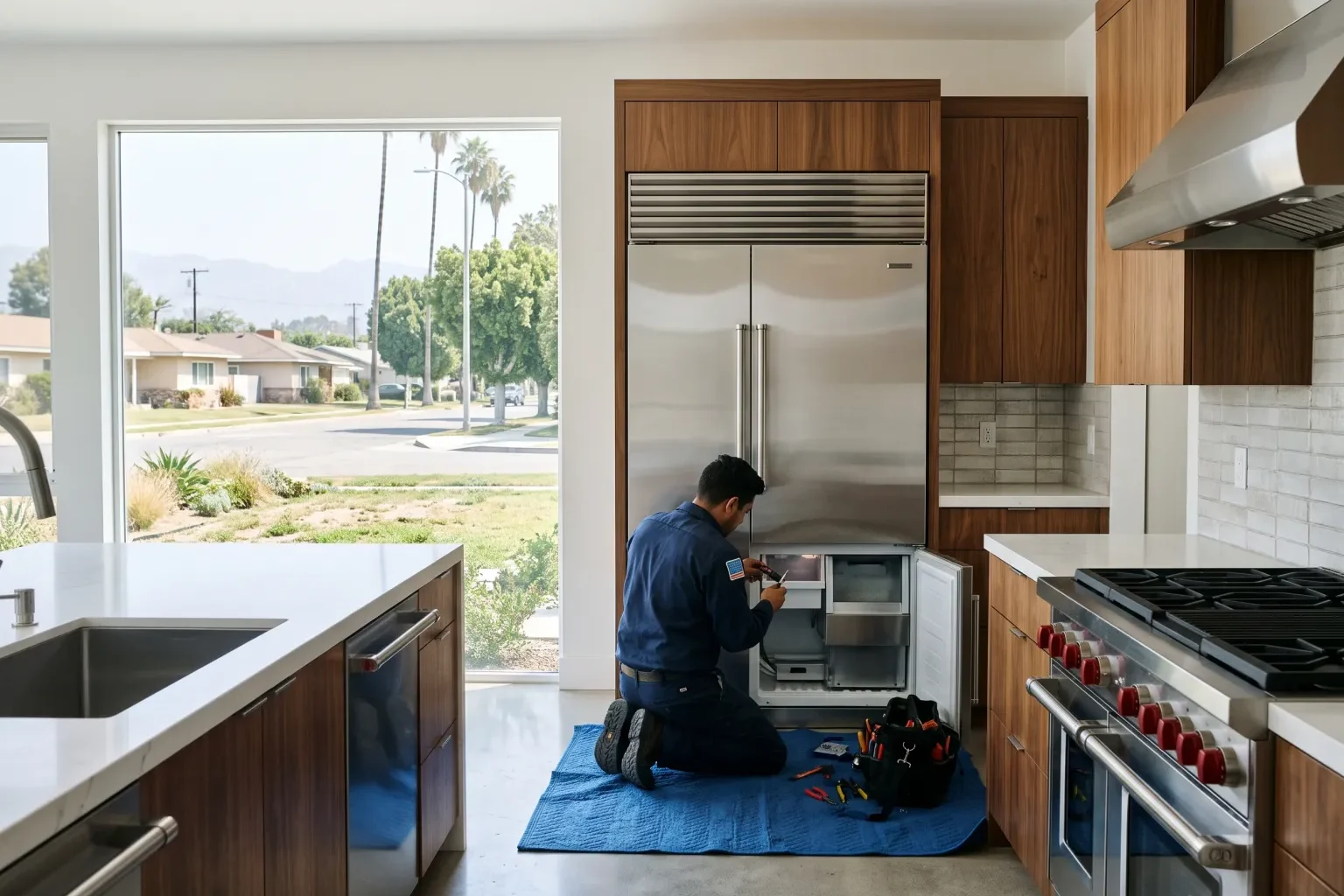
When an ice maker stops working, the cause is usually a single part: a water valve, a frozen line, a sensor, or a drain. On a built-in refrigerator or an undercounter ice machine, getting to that part takes care, because the unit sits inside custom cabinetry and is often tied into the home's plumbing and drain lines. Viking Appliance Services repairs ice makers in premium kitchens across Los Angeles and nearby cities. We work on Viking, Sub-Zero and Thermador refrigeration and undercounter ice units, and we often serve kitchens built around Wolf cooking equipment. We are an independent repair company, not affiliated with any of these brands. Our goal is to find the actual fault, explain it plainly, and fix it without disturbing the cabinetry around it.
Issues we fix
Homeowners usually call us after noticing one of the following. Some point to a simple supply problem. Others mean a component inside the ice maker or the refrigerator needs attention.
- No ice at all, even though the refrigerator or freezer is cold
- Slow ice production or a bin that never fills
- Small, hollow, cloudy or misshapen cubes
- Ice clumped together or frozen into a solid block in the bin
- Water leaking onto the floor or pooling under an undercounter unit
- Frost build-up around the ice maker or a frozen fill tube
- An undercounter ice machine that won't drain or keeps tripping a drain alarm
- Error codes, flashing lights or a service indicator on the control panel
- Ice that tastes or smells off, often tied to the filter or scale build-up
- Clicking, buzzing or grinding when the ice maker tries to cycle
- An ice maker that runs but the freezer section isn't cold enough
What our technician checks
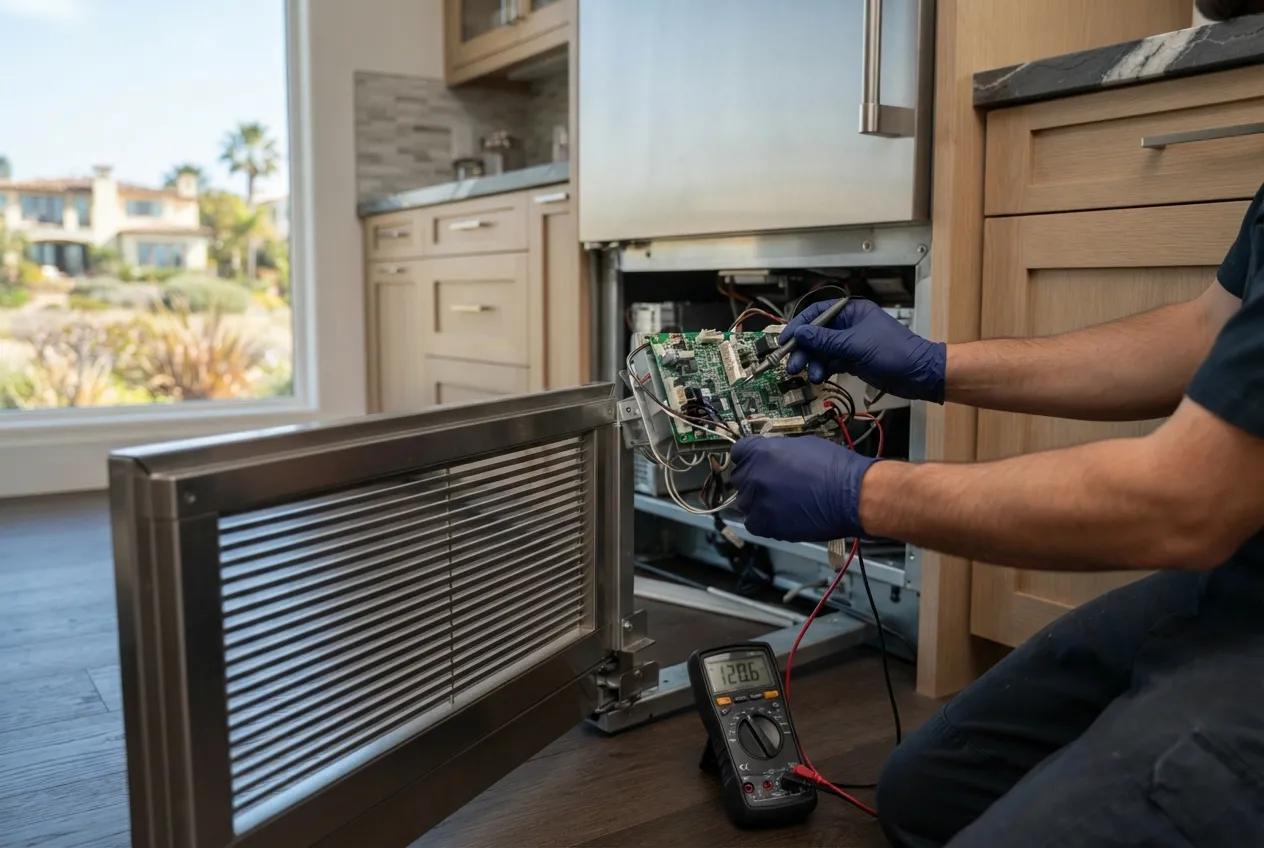
We start with the basics that are easy to overlook: the water supply valve behind or below the unit, the filter, and the water pressure reaching the appliance. A clogged filter or a partly closed valve can produce the same symptoms as a failed part, so we rule those out first.
From there we test the water inlet valve, inspect the fill line for ice blockages or kinks, and check the ice maker module, including its motor, ejector, heater and thermostat. We confirm the bin sensor or shutoff arm is reading correctly, since a stuck sensor tells the unit the bin is full when it isn't. We also measure freezer temperature, because an ice maker can't keep up if the compartment itself is running warm.
On undercounter ice machines we look at the evaporator plate, water distribution, the drain pump or gravity drain, and any scale on internal surfaces. Where water is hard, mineral deposits build up over time and slow the harvest cycle. Units in hot spaces, such as outdoor kitchens, bars or garages in the inland valleys, work harder in summer and during fall Santa Ana heat. We check condenser airflow and ventilation in those spots.
How the brands differ
Viking built-in refrigerators and Viking undercounter ice machines commonly come to us with inlet valve failures, ice maker assembly problems and, on undercounter models, drain and scale issues. Clear-ice machines are sensitive to water quality and need regular cleaning to keep producing.
Sub-Zero built-in and integrated refrigerators use ice makers that are generally reliable, but we see frozen fill tubes, worn valves and ice maker modules that stop cycling. Sub-Zero also makes dedicated undercounter ice makers, which share many of the drain and descaling concerns of other clear-ice units.
Wolf is a cooking line, so it doesn't make ice makers. In kitchens with a Wolf range or wall oven, the ice comes from a paired refrigerator or a separate undercounter unit, often a Sub-Zero. We service those units and can work around the surrounding cooking equipment when access is tight.
Thermador column and built-in refrigerators tend to bring us ice maker modules that won't eject, sensor faults, and water delivery problems traced to the valve or the filter housing. Electronic controls on newer models can display codes that help narrow down the fault.
Tell us what your appliance is doing.
Repair or replace?
On a premium built-in or undercounter unit, the ice maker is almost always worth repairing. Valves, modules, sensors, pumps and fill lines are replaceable parts, and fixing them costs far less than removing and replacing an appliance fitted into custom cabinetry.
Replacement becomes worth discussing when the sealed cooling system has failed, such as a compressor or a refrigerant leak, on an older unit, when the cabinet or liner is damaged, or when the needed parts are discontinued. If we reach that point, we'll explain what we found and what each path involves so you can decide.
What affects the cost
We don't quote a repair until we've diagnosed it, because the same symptom can have very different causes. A few factors shape the final cost.
- The fault itself: a clogged filter or frozen line is simpler than a failed module or control board
- Parts: brand-specific components vary, and some take longer to source
- Access: units built into custom panels or tight cabinetry may need careful removal or extra time
- Plumbing and drains: problems in the supply line or drain path outside the unit can add work
- Condition: heavy scale or long-standing leaks may mean cleaning or repairing more than one part
How a visit works
When you contact us, we'll ask for the brand, model if you have it, and what the ice maker is doing. That helps the technician arrive prepared. On site, we inspect the unit, test the likely components, and explain the cause in plain terms before any repair begins.
If the needed part is on hand, we can often finish the repair during the same visit. If it has to be ordered, we'll tell you what's coming and schedule a return. Before we leave, we confirm water is reaching the ice maker, check for leaks, and walk you through how long a full first batch of ice should take to make.