


The short answer
Most warming drawer problems come from a failed heating element, a faulty thermostat or temperature sensor, a control or switch issue, or worn slides and gaskets, and nearly all of them can be repaired. A technician tests the heat circuit and controls and inspects the drawer hardware before recommending a fix, so you know whether repair makes sense for your unit.
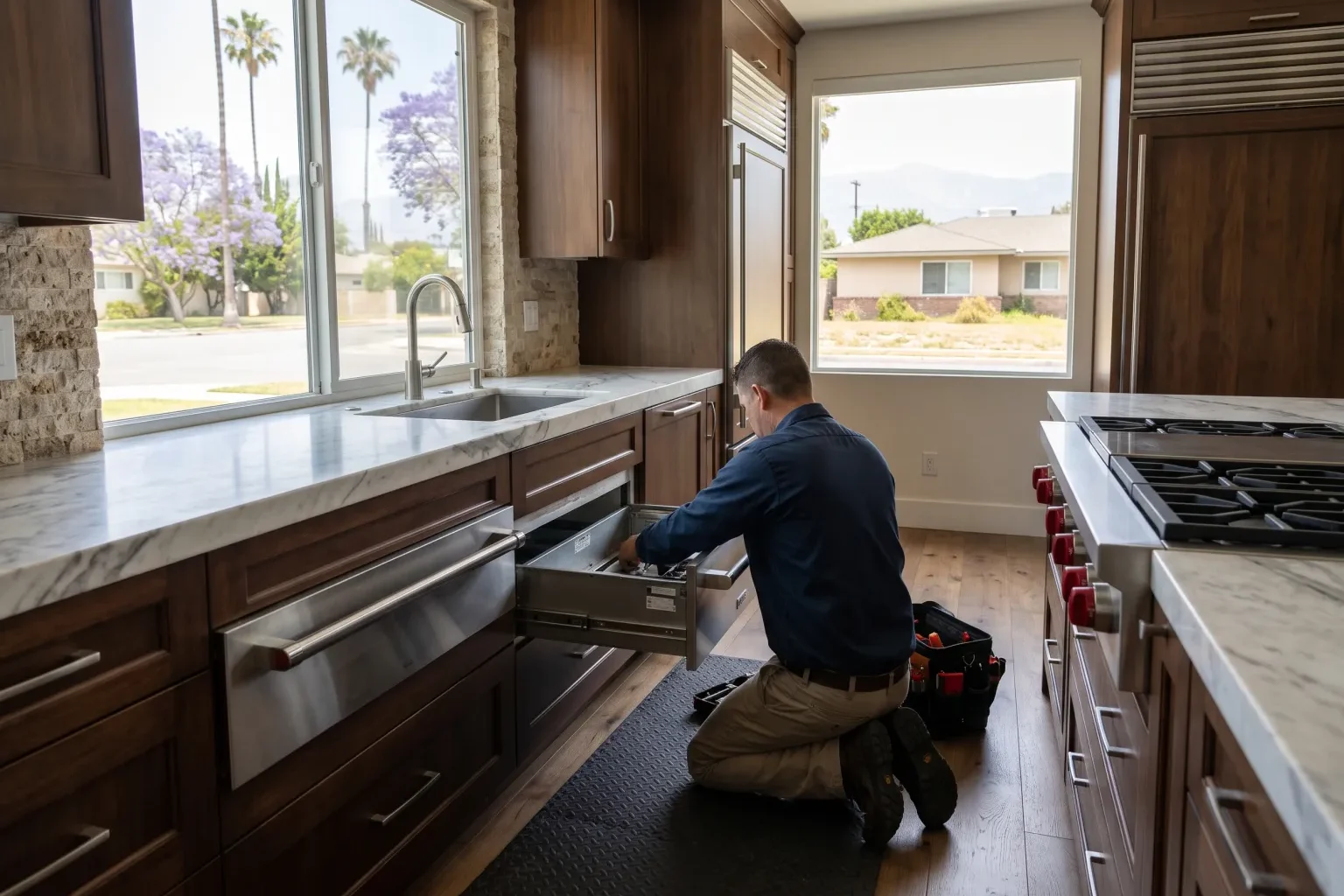
A warming drawer has one job: hold food at a steady, gentle heat without drying it out. When it runs cold, overheats, or the drawer won't open and close smoothly, it quickly stops being useful. Viking Appliance Services repairs built-in and professional-style warming drawers in homes across Los Angeles and nearby cities. We work mainly on Viking units and on the drawers found in kitchens built around Sub-Zero refrigeration, Wolf cooking, and Thermador appliances. We're an independent repair company, not affiliated with any manufacturer, and we focus on finding the actual cause before replacing anything.
Issues we fix
Warming drawers have fewer parts than an oven, so symptoms usually point toward a short list of causes. These are the problems homeowners call us about most often:
- Drawer doesn't heat at all, or the indicator light comes on but the inside stays cold
- Uneven heat, with one side or the back much warmer than the front
- Drawer runs too hot and dries out or overcooks food
- Temperature setting doesn't match what the drawer actually holds
- Moisture or humidity control doesn't seem to change anything
- Controls, knobs, or touch panel unresponsive, or the unit shuts off on its own
- Indicator or power lights stay on when the drawer is off
- Drawer sticks, drags, or won't close fully, or the push-to-open mechanism fails
- Heat escaping around the front because of a torn or flattened gasket
- Burning smell, tripped breaker, or visible scorching near the element
What our technician checks
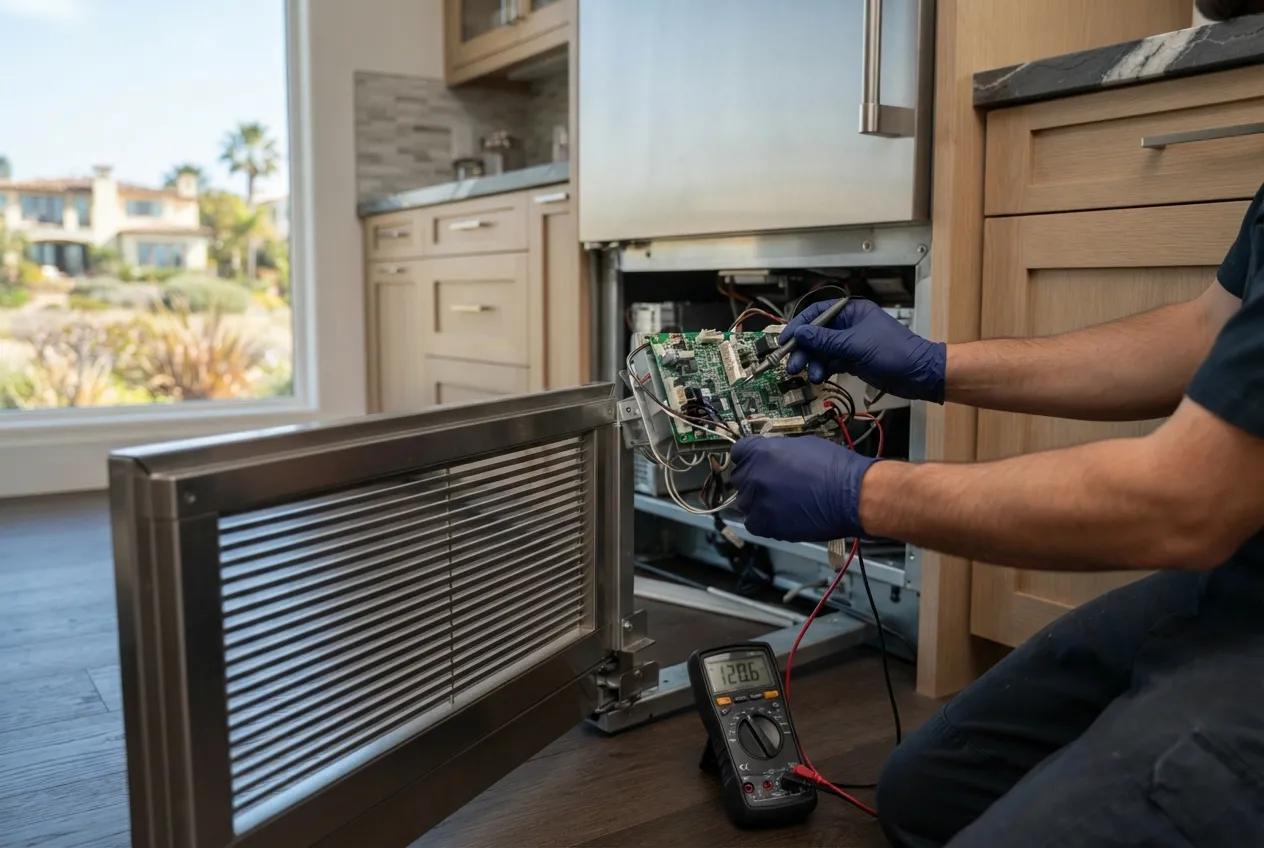
On a built-in or professional-style drawer, we start by confirming the complaint: we run the drawer and measure the actual temperature inside at different settings. That tells us right away whether we're dealing with no heat, weak heat, or poor regulation.
From there we test the heating element for continuity and resistance, check the thermostat or temperature sensor against its specification, and look at the control switch, selector, or electronic board depending on the model. We inspect wiring and terminals for heat damage, which is common on appliances that run warm for hours at a time. We also verify that the circuit is supplying the right voltage, since a loose connection or tripping breaker can look like a failed part.
Finally, we look at the mechanical side: drawer slides, rollers, the door gasket, and any humidity vent or moisture control. A drawer that doesn't seal fully will never hold an even temperature, no matter how well the element works.
How Viking, Sub-Zero, Wolf and Thermador drawers differ
Viking warming drawers are built to match its professional-style ranges and wall ovens, and many have been in service for a long time. On older Viking units we commonly find tired heating elements, worn infinite switches or thermostats, and slides that have loosened from years of heavy use. Gasket wear is also common on drawers that get opened constantly during entertaining.
Sub-Zero is known for refrigeration rather than cooking, so in a Sub-Zero kitchen the warming drawer is usually a Wolf unit installed alongside it. Wolf drawers often use electronic controls and a humidity setting, so diagnosis tends to focus on the control board, the temperature sensor, and the moisture control as well as the element. Many Wolf models also use handle-free push-to-open hardware that can wear or go out of adjustment.
Thermador warming drawers are frequently paired with its wall ovens and may include features like low-temperature or proofing modes. Problems we see include sensor and control faults, element failure, and slide or latch issues. Because each brand uses its own parts, we identify the exact model and serial number before ordering anything.
Tell us what your appliance is doing.
Repair or replace?
On a high-end warming drawer, repair is usually the better choice. The housing, drawer box, and front panel rarely wear out, and the parts that do fail, like elements, sensors, switches, slides, and gaskets, are replaceable. A drawer with a custom panel that matches your cabinetry is also difficult to swap out without affecting the look of the kitchen.
Replacement starts to make more sense when the control board and other major components have failed at the same time, when parts for an older model are no longer available, or when there's significant heat or corrosion damage to the frame. If we reach that point, we'll explain what we found and let you decide.
What affects the cost
The cost of a warming drawer repair depends mainly on the fault itself. Replacing a gasket or adjusting slides is a smaller job than replacing an electronic control board. Parts availability matters too: some components are stocked widely, while others for older or less common models take longer to source.
Access is the other big factor. Many drawers are installed beneath wall ovens or set into custom cabinetry with integrated panels, and some repairs require pulling the unit out of its opening. We'll look at how your drawer is installed and give you a clear quote for the work before we begin.
How a visit works
When you contact us, we'll ask for the brand, the model number if you can find it (usually on a label visible when the drawer is open), and a description of what's happening. That helps the technician arrive prepared.
At the appointment, the technician tests the drawer, explains what's wrong, and gives you the repair options. If the part is on hand, many repairs are finished the same visit. If a part has to be ordered, we schedule a return trip to install it and confirm the drawer is heating and holding temperature correctly before we leave.