


The short answer
Most outdoor grill problems in Los Angeles come from ignition parts, blocked burners or venturi tubes, worn valves, and corrosion, and nearly all of them can be repaired without pulling the grill out of the island. A technician checks gas supply, ignition, burners and safety parts, then tells you whether repair or replacement makes more sense for your unit.
A built-in grill is the center of most outdoor kitchens, so when burners won't light, the flame turns weak and yellow, or one side of the grate barely gets warm, the whole space stops being useful. Viking Appliance Services repairs high-end outdoor gas grills for homeowners in Los Angeles and nearby cities. We work mostly on Viking and Wolf built-in and freestanding grills, and we also service the Sub-Zero outdoor refrigeration and Thermador cooking equipment that often share the same kitchen. We are an independent repair company, not affiliated with any of these brands. Our goal on every visit is to find the actual cause, explain it clearly, and fix it in place whenever that makes sense.
Issues we fix
These are the problems homeowners describe most often when they call about an outdoor grill. If you smell gas at any point, turn off the supply at the tank or shutoff valve, don't try to light the grill, and contact your gas utility before scheduling a repair.
- Burners that won't ignite, or an igniter that clicks without lighting
- Ignition that only works on some burners, or only with a match
- Weak, lazy, or yellow flames instead of a steady blue flame
- Uneven heat across the cooking surface, or a grill that won't get hot enough
- Flames that go out on their own after lighting
- Infrared sear or rear rotisserie burner that won't glow or light
- Rotisserie motor that won't turn
- Stiff, loose, or sticking control knobs and valves
- Excessive flare-ups or grease that isn't draining to the tray
- Interior or control-panel lights that stopped working
- Rust, warped heat shields, or burners with holes rusted through
What our technician checks
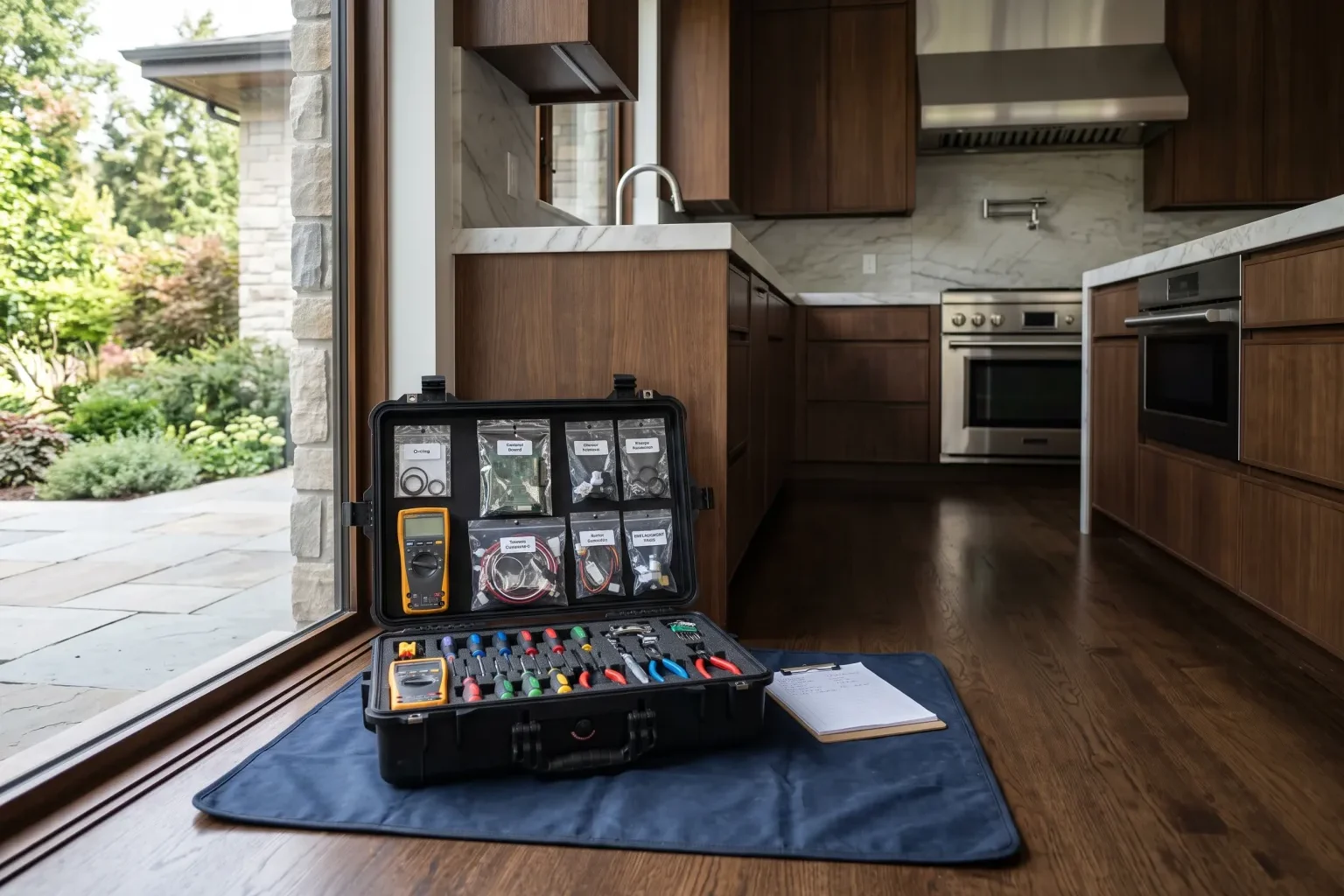
On a built-in grill, the parts that matter are often tucked behind the control panel or under the firebox, inside the island. We start by confirming that the right amount of gas is reaching the grill: whether the unit is set up for natural gas or propane, the condition of the regulator and supply line, and whether the shutoff valve is fully open. A grill converted incorrectly, or a regulator that is failing, can look like a burner problem.
From there we test the ignition system, including the spark module, electrodes, wiring and power source, and check the safety parts that shut off gas when no flame is detected. We remove and inspect burners, orifices and venturi tubes for blockages. Spiders and insects like to nest in venturi tubes during the months a grill sits unused, and that alone can cause weak or yellow flames. We also look at valves, heat shields and flame tamers, grease management, rotisserie and lighting circuits, and the ventilation openings in the island itself, since a poorly vented enclosure can create its own problems.
Weather is part of the picture here. Los Angeles has dry summers and mild winters, and inland valleys get much hotter than neighborhoods near the coast. Grills near the ocean tend to show more corrosion on burners, igniters and fasteners, while grills in hot inland yards see more wear on wiring and knobs. Dust and debris blown in during fall Santa Ana winds can also clog burner ports and electrodes.
How the brands differ
Viking outdoor grills are heavy stainless units, and many models include a rear infrared rotisserie burner and lighting. The repairs we see most often involve ignition components, valves that have stiffened over time, and main burners worn down by heat and moisture. Wolf outdoor grills commonly pair standard burners with an infrared sear zone, a rotisserie and interior lights, so ignition, the sear burner and lighting are frequent service points. On both brands, cover use and cleaning habits have a big effect on how long burners and igniters last.
Sub-Zero makes refrigeration rather than grills, but its outdoor refrigerators and drawers are often installed right next to a grill in the same island. If one has a cooling problem, we can look at it during the same visit. Thermador grilling equipment we see is mostly indoors, such as the griddle and grill sections of ranges and rangetops. Those use different parts than a freestanding outdoor grill, so let us know the exact model when you book.
Tell us what your appliance is doing.
Repair or replace a high-end grill
Most premium grills are built around a stainless firebox and frame that can outlast many of the parts inside them. Igniters, valves, burners, heat shields and rotisserie motors are designed to be replaced, so a grill with a solid body is usually worth repairing. A built-in grill also sits in a cutout sized for that specific model, which makes replacement more than a simple swap.
Replacement starts to make sense when the firebox or frame is rusted through, when several major parts have failed together, or when parts for an older model are no longer available. We'll tell you plainly what we find so you can decide.
What affects the cost
The final cost depends on three main things. The first is the fault itself: cleaning a blocked venturi tube is a very different job from replacing a set of valves. The second is parts, since some components are stocked widely and others have to be ordered for a specific model. The third is access. A grill set deep into custom stonework or tile can take extra time to reach, especially for repairs on gas lines or under-firebox parts. We explain the diagnosis and the proposed repair before any work begins.
How a visit works
When you contact us, tell us the brand, model number if you can find it, whether the grill runs on natural gas or propane, and what you're seeing. The model number is often on a tag under the control panel, inside the grease tray area, or on the back of the unit.
At the visit, the technician inspects and tests the grill, explains what's wrong, and walks you through your options. If the part is available, many repairs are finished that day. If a part needs to be ordered, we schedule a return visit to complete the work and test every burner before we leave.